

Buying gold safely online starts before you send money: establish who you are dealing with, identify exactly what you will own, and get the complete purchase and resale terms in writing. A polished website, a favourable review or an attractive gold-price forecast cannot answer those questions for you.
I have used several bullion providers, but I would still check the actual transaction each time. A service that worked well for one customer can have different eligibility, delivery or account requirements for another. This checklist is a way to organise your research, not a certificate that a seller is safe.
Start with the company, not the advertisement
Reach the provider through an independently checked website address. Compare the legal business name, business address and published contact details with independent records available in its home jurisdiction. An email display name or a familiar-looking logo does not establish who receives the money.
Search for a pattern of complaints as well as positive reviews. Look at what happened when customers tried to withdraw money, receive metal or resolve a dispute. Distinguish detailed reports from unsupported accusations, and do not mistake the absence of complaints for proof of a reliable business.

Separate product ownership from account access
An account balance labelled gold is a starting point for questions. Are you buying a coin for delivery, identified metal in storage, a share of pooled bullion, or a financial claim? Who is the contracting entity, where is the metal held, and what records support your ownership?
For delivered bullion, request the exact product, fine-metal content, condition and delivery arrangements. For vaulted holdings, read the custody contract and identify the withdrawal and sale process. If the provider cannot explain what you own in terms you understand, pause rather than filling the gaps with assumptions.
Get a written quote that you can compare
Ask for the full price, payment charges, delivery or custody costs, and a buyback quote for the same product. Confirm how long the quote is valid and when the order becomes binding. A moving spot-price display is a reference, not necessarily the price at which your order will execute.
The CFTC and FINRA’s precious-metals advisory encourages buyers to obtain fees in writing and ask what they would receive on an immediate sale. The advisory is written in a US context, particularly retirement-account sales; its cost questions are useful more broadly, but its legal rules should not be applied to every country.

Hypothetical example: a product costs $4,200, delivery adds $40, and the dealer would currently buy the same product for $3,950. Your initial outlay is $4,240 and the difference from that buyback quote is $290, before any return shipping. This is a transaction-cost comparison, not an estimate of tomorrow’s gold price.
Recognise pressure that prevents proper checking
Treat guaranteed returns, crisis countdowns and demands for an immediate transfer as reasons to stop and verify the offer. The CFTC’s fraud material describes high-pressure selling, inflated prices and arrangements in which promised metal was not bought or stored. Owning a physical commodity does not make the sales process immune to fraud.
Be especially careful if a straightforward cash purchase turns into borrowing or a leveraged trade. That changes both the product and the potential loss. Do not accept a complex arrangement merely because a salesperson presents it as the only way to obtain a favourable price.
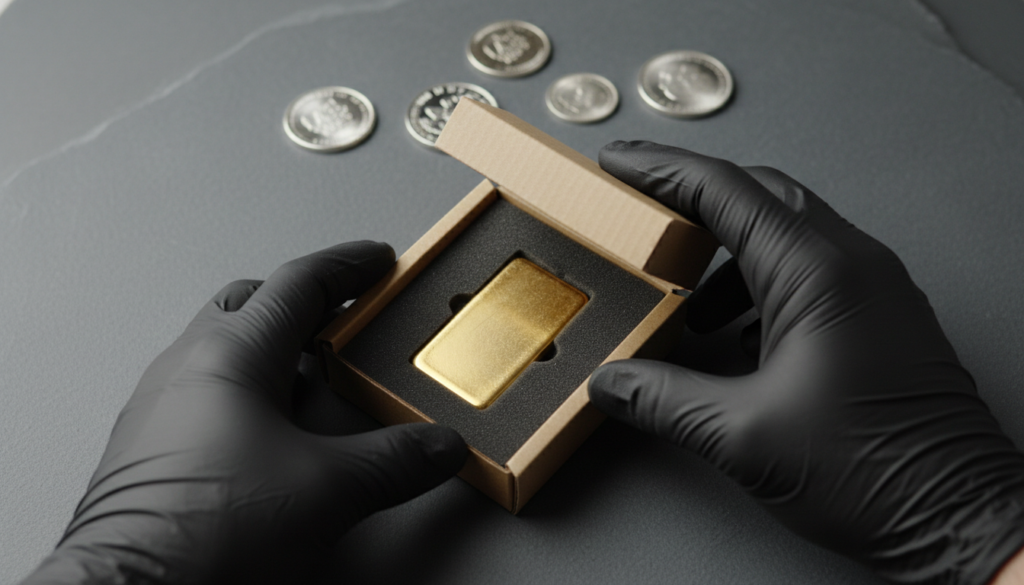
Check the payment and delivery instructions
Compare the beneficiary details with the provider’s official instructions for your order or account. If payment details change unexpectedly, verify them using an independently obtained contact method. Do not rely solely on a reply to the message that announced the change.
Before a shipment, establish who insures it, what delivery evidence is required and how to report a missing or damaged parcel. Keep the invoice, confirmation and relevant correspondence. For stored metal, reconcile the completed trade with your holding statement and retain the records separately from your login.
Make the first purchase a controlled process
1. Finish identity, ownership and cost checks before transferring funds.
2. Use the provider’s available account-security features and a unique password.
3. Keep a record of the product specification and agreed terms.
4. Verify receipt or the recorded holding after the purchase.
5. Understand how to sell and receive proceeds before increasing your exposure.
You can compare the providers I have personally used without treating that list as a guarantee. Read what those experiences taught me, and return to the Buygold homepage for the broader buying and ownership guides.
Sources: CFTC and FINRA: questions before buying physical metals and CFTC precious-metals fraud guidance. Checked 28 October 2026. This is general education; checks reduce uncertainty but cannot eliminate fraud or investment losses.